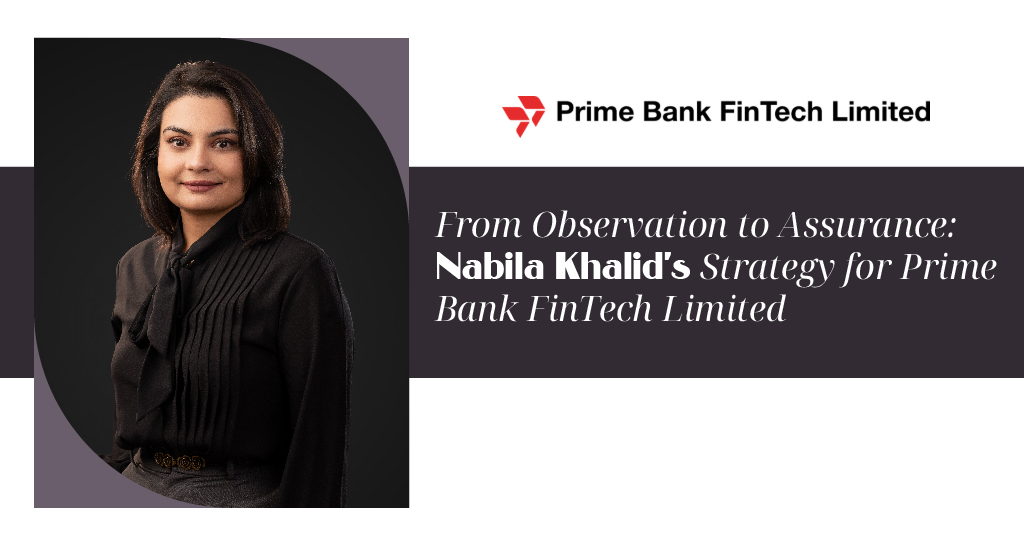

Meet Nabila Khalid – a Consumer Behavior Expert and Telecom communication expert. As the Head of Brand & Communication at Prime Bank FinTech Limited, she builds data-informed, customer first narratives that turn complex technology into simple brand stories—driving product adoption, defining market identity, and building trust at scale.

Her leadership comes at a pivotal moment for Prime Bank FinTech Limited (PBFTL), the digital finance services arm of Prime Bank PLC. PBFTL is entering a mature, highly saturated market where bKash and Nagad command consumer trust, daily engagement, and large-scale network effects. With functional parity across payments, transfers, and cash-in/out now the industry standards, and telco backed digital banks such as Somadhan and Banglalink accelerating the shift to full-scale digital banking, competitive advantage no longer rests on features or pricing.
Here, Nabila’s purpose is clear: position PBFTl through clarity, credibility, and customer value—ensuring the brand enters not just as an option but as a necessary new voice in the sector.
Driven by Human Truth
Nabila’s journey into brand leadership and communication did not begin with advertising—it began with observing people. She has always been deeply curious about how people think, what moves them, and why they make the choices they do. Over time, she realized that the most powerful brands are not built on visibility but on understanding human truth. That realization shaped everything that followed in her approach to brand and communication strategy.
Bridging Markets, Building Connection
Having held impactful roles across Grameenphone and global agencies, Nabila developed a layered perspective from working in markets such as the USA, Australia, and Bangladesh. She observes that mature markets are often data-led but emotionally distant, while emerging markets are emotionally rich but sometimes lack strategic discipline. Her voice as a speaker has been shaped by bridging these two worlds, where empathy is disciplined by intelligence. She does not believe in communication that performs; she believes in communication that connects and converts.
Real Drivers of Fintech Inclusion in Asia
When discussing fintech innovation and financial inclusion in Asia, Nabila believes the most important message is clear: access is not inclusion. In her view, giving people access to financial tools does not automatically make them financially empowered. She emphasizes that true inclusion requires trust, literacy, usability, and cultural relevance. If people do not understand a product, trust it, or see themselves in it, they will not use it—no matter how innovative it is.
Building Credibility in Fintech Communication
Nabila notes that fintech operates in a space where the product is invisible and the risk is deeply personal—people’s money. In her view, communication cannot just be persuasive; it must be reassuring. She believes trust is built through consistency across every touchpoint—the tone, the interface, the customer experience, and the responsiveness all communicate. For her, transparency is not a campaign message but a system that must show up repeatedly to build credibility among users.
Aligning Brand With Fintech’s Mission
For Nabila, aligning brand communication with a company’s broader mission of financial inclusion and digital innovation requires discipline. She believes it is easy to say “we are inclusive,” but much harder to operationalize it. In her approach, every piece of communication must answer one question: Does this make financial systems feel more accessible or more intimidating? If it creates distance, she views it as working against the mission. Her principle is that communication must simplify, not complicate.
From Engagement to Assurance
When transitioning into the fintech space, Nabila encountered a fundamental shift—moving from engagement-driven communication to responsibility-driven communication. She notes that in telecom, there is room to be expressive and experimental, whereas in fintech, every message carries weight. She had to recalibrate her approach—from storytelling that captures attention to storytelling that builds assurance. For her, the goal is not just to make people feel something but to make them feel safe enough to act.
Building Trust in Digital Finance
According to Nabila, communication leaders can help build trust in emerging digital financial ecosystems because technology alone cannot solve trust deficits. She believes people trust people, not systems, which means brands must humanize technology—through tone, representation, responsiveness, and accountability. Most importantly, she emphasizes that when something goes wrong—and it will—how a brand communicates in that moment defines its credibility far more than any campaign ever could.
Leadership Advice to Young Professionals
When engaging with young professionals and aspiring business leaders, Nabila shares that leadership is not about authority; it’s about clarity. She defines leadership as the ability to challenge the obvious, humanize systems, and leave people stronger than they were found —titles come later. She also reminds them that growth is not always visible and that many defining moments come from discomfort, not success.
Asia’s Role in Global Innovation
Nabila sees Asia rapidly emerging as a hub for innovation and leadership that is not just catching up—it is redefining the conversation. She notes that the region operates at a unique intersection of scale, diversity, and constraint, which drives innovation that is both practical and impactful. Especially in fintech, she believes Asia is leading not just in adoption, but in building systems around real human needs.
The Future Roadmap
Looking ahead, Nabila remains focused on building communication that is not just effective but meaningful. Whether through her work or through speaking, she wants to continue shaping conversations around ethical communication, inclusive systems, and human-centered strategy. She holds that at its core, good strategy is simple—it is empathy, disciplined by intelligence.