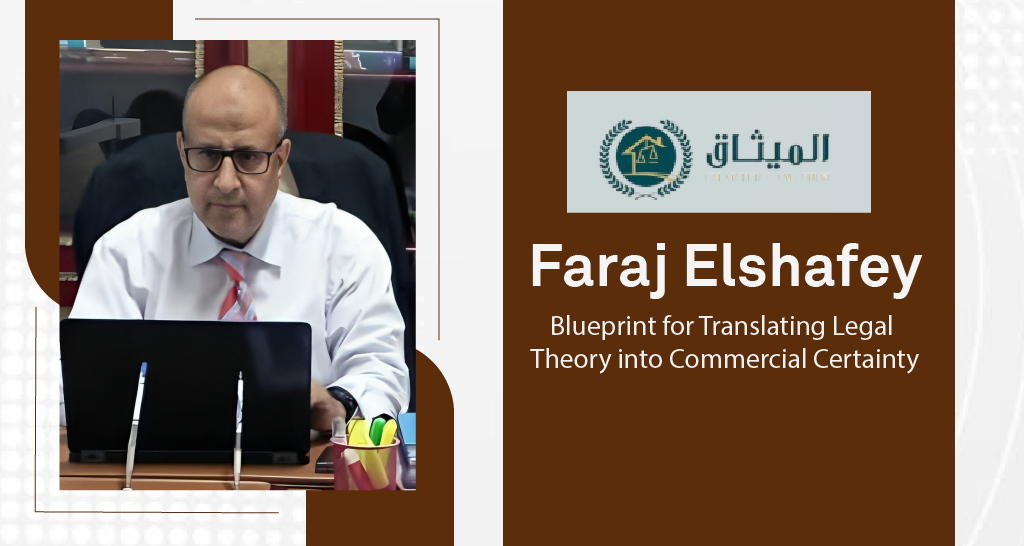

Faraj Elshafey is the Chief Legal Officer of Charter Law Firm and a veteran legal consultant with over 30+ years of expertise. A scholar of international economic law, labor law, and dispute resolution, he specializes in converting complex regulatory frameworks into enforceable commercial results. By bridging the gap between legal theory and operational compliance, Faraj Elshafey empowers international companies and regional institutions to go beyond transactional counsel and build a robust legal ecosystem where transparency and reform are structural, not aspirational.

The Key Inspiration behind Joining the Firm
With over three decades of experience in arbitration, corporate law, and commercial litigation, Faraj Elshafey was not drawn to law as a profession in its narrow sense. He was drawn to the idea that law is one of the few disciplines through which society negotiates justice, authority, obligation, and dignity.
For Faraj Elshafey, law sits at the intersection of principle and power. It governs transactions and also trust. It resolves disputes, but it also reveals how a society understands fairness.
That conviction has only deepened over the years. His legal practice has never been limited to technical drafting or adversarial representation. Faraj Elshafey remains focused on a deeper legal question: what happens when legal text says one thing, social reality says another, and justice requires confronting the distance between both.
This perspective is visible in his writing as much as in his casework. Whether discussing family justice, judicial ethics, arbitration, or corporate risk, he approaches law as both a professional discipline and a civilizational responsibility.
How Comparative Law Became His Cross-Border Advantage
Faraj Elshafey’s cross-border legal expertise was shaped by three decades of work across Egypt and the Gulf on disputes, contracts, governance, compliance, and investment-related matters. More clinically, it was forged through a habit of comparative legal thinking. He does not see legal systems as isolated silos. He sees them as different answers to the same enduring questions: how to allocate risk fairly, how to protect confidence in institutions, and how to balance freedom with accountability.
That comparative method is central to his practice. In his public legal writing, Faraj Elshafey has examined how different jurisdictions regulate the transition of judges into legal practice, comparing Egypt with France, England, Germany, the United States, the Gulf, and the Maghreb. This is not an academic interest only. It reflects how he approaches legal tension by extracting practical lessons from those comparisons.
His work on Saudi-related arbitration and construction documentation illustrates the same approach. So does his doctrinal analysis of Saudi arbitration. Faraj Elshafey focuses not only on what the rule is, but also on how it is justified, how it functions institutionally, and whether it is aligned with the legal culture and constitutional framework in which it operates.
The Genesis of Charter Law Firm
Charter Law Firm was born from Faraj Elshafey’s desire to create a legal practice that is not merely transactional but interpretive, strategic, and intellectually serious. He set out to build a firm capable of serving clients in complex commercial and regulatory matters while also engaging larger questions of legal development, institutional credibility, and legal reform.
The word “Charter” was deliberate from the beginning. A charter is not only a document; it is a framework, a statement of order, and a promise of structure. That choice reflects how Faraj Elshafey views the role of legal counsel. Good lawyers do not simply react to crises. They help define the framework within which business, investment, and dispute resolution can proceed with confidence.
The firm also embodies a principle evident in his writing: legal practice in the MENA region must move between the boardroom, the court, the arbitral forum, and the public square. For Faraj Elshafey, law firms should not only solve problems after they arise; they should help shape a better legal culture.
Focusing on Client Realty First, Legal Form Second
Faraj Elshafey tailors legal strategy by starting with the client’s operating reality rather than with abstract legal form. For a multinational corporation, the central concerns often include governance discipline, multi-jurisdictional consistency, compliance architecture, contract standardization, and dispute avoidance across complex operations. For a high-growth business, the need is different: speed, scalability, investor-facing legal credibility, and protection without paralysis.
What remains constant is his method. Faraj Elshafey identifies the real axis of the matter. In one of the articles, he wrote that family financial disputes are not just questions of numbers but of intention, classification, fairness, and the danger of confusing gift, duty, and earned right. That same logic applies in commercial practice. Many legal disputes persist because parties confuse categories: risk is treated as entitlement, discretion as authority, and commercial flexibility as obligation. For Faraj Elshafey, resolving the category error is often the key to resolving the dispute.
The Key Differentiating Factors
What differentiates Charter Law Firm’s evolving legal realm is its combination of legal precision with interpretive depth. The firm does not only answer “What does the law say?” It also asks: what is the legal risk beneath the text, what institutional logic does the matter implicate, and what outcome is commercially sustainable?
Faraj Elshafey’s published writing reflects this approach. In one article, he explored how unspoken custom can produce a legal and social hierarchy not expressly codified in formal law. In another, he distinguished between formal equality and substantive justice in financial family claims. In a comparative article, he traced how several jurisdictions regulate post-judicial legal practice to preserve public confidence. These are not disconnected themes. They reflect the same professional instinct: to read law not as isolated clauses but as a living system shaped by doctrine, institutions, and social reality.
The Key Trends in Africa’s Legal Infrastructure
Faraj Elshafey identifies four key trends shaping Africa’s legal industry. First is the growing recognition that legal infrastructure is economic infrastructure. African markets are becoming more sophisticated, but investment depends not only on opportunity. It depends on enforceability, transparency, regulatory credibility, and dispute-resolution trust.
Second is the rise of legal specialization in sectors like infrastructure, healthcare, energy, technology, and cross border investment. Third is the centrality of compliance. Anti-corruption, corporate governance, ethical supply chains, sanctions awareness, and internal accountability are now core legal-business concerns.
The fourth trend is intellectual maturity within the profession itself. African legal markets increasingly require lawyers who can think comparatively, work across languages, advise strategically, and contribute to reform debates—not just execute instructions.
The Primary Strategy to Strengthen Global Competitiveness
Faraj Elshafey argues that African law firms can strengthen global competitiveness by investing in substance before image. Real competitiveness comes from specialization, quality control, multilingual ability, sector understanding, strong research culture, and disciplined client service.
He adds the sixth element: thought leadership rooted in the realities of the continent. Law firms become globally respected when they are not only technically competent but also intellectually useful. They must be able to explain markets, interpret reform, compare systems, and participate in shaping legal discourse. According to Faraj Elshafey, African firms should not aspire merely to imitate external models. They should aspire to contribute original legal thinking from within their own jurisdictions and legal traditions.
Legal Infrastructure: An Engine of Growth and Foreign Investment
For Faraj Elshafey, legal infrastructure is indispensable to economic growth. Investors can price commercial risk; what they struggle to price is legal unpredictability. If contracts are not enforceable, if regulatory processes are opaque, or if dispute resolution is too slow or too uncertain, capital either becomes expensive or goes elsewhere.
Strong legal infrastructure does more than protect investors. It also protects local enterprise, strengthens credit, supports entrepreneurship, and reduces friction in domestic commerce. In that sense, law is not a background condition of growth. It is one of its engines.
Regional Collaboration in Harmonizing Legal Systems
For Faraj Elshafey, regional collaboration is critical. Africa’s commercial future depends on greater legal interoperability, especially in trade, investment, logistics, arbitration, and regulatory compliance. Total uniformity is neither possible nor necessary. What matters is reducing unnecessary fragmentation and developing a shared language of legal expectations.
Comparative work is vital here. His writing has consistently engaged with the value of comparing systems—not for imitation, but for calibration. Regional cooperation should work the same way: jurisdictions learning from one another while remaining faithful to their own legal identities.
Influence of Technology in the Legal Profession
Faraj Elshafey sees legal technology changing the speed, visibility, and structure of legal work. In disputes, it improves document handling, chronology construction, evidence mapping, and strategic case preparation. In compliance, it enhances monitoring, reporting, internal control, and pattern detection.
Yet for Faraj Elshafey, the true future is not technology instead of judgment. It is technology in the service of judgment. The lawyer of the future will need to combine legal reasoning, ethical sensitivity, and digital fluency. The profession will reward those who can integrate all three.
Improving Legal Efficiency with Digital Tools
For Faraj Elshafey, digital tools and data analytics allow law firms to become more proactive, more accurate, and more accountable. They help identify recurring contractual risks, improve turnaround time, track obligations, and strengthen client reporting.
But they also improve something less visible: legal discipline. When a firm uses systems properly, it becomes better at consistency, knowledge retention, and institutional memory. That directly improves client service.
Mentoring Lawyers to Distinguished Not Just Drafting
As a senior legal leader, Faraj Elshafey mentors younger lawyers by insisting on depth, clarity, and responsibility. He expects them to master doctrine but also to understand why doctrine matters in the lives of clients and institutions. He pushes them to write clearly, think comparatively, and recognize that legal language has consequences.
Faraj Elshafey also encourages them to avoid superficial equality in legal reasoning. Justice is rarely mechanical. In one public article, he argued that fairness is not always arithmetic sameness; sometimes it is the discipline of putting each right in its proper place. That is a principle he brings into mentoring as well. Young lawyers must learn how to distinguish categories, diagnose real interests, and resist oversimplification.
The Long-term Vision for Charter Law Firm
Faraj Elshafey’s long-term vision is for Charter Law Firm to become a respected regional platform for high-level legal work involving Africa, the Middle East, and international investment. He wants the firm to be recognized not only for technical excellence but also for seriousness of thought, integrity of service, and contribution to legal development.
Faraj Elshafey also intends for the firm to help build a stronger culture of legal writing and public legal discourse. Law firms should not only serve clients privately; they should clarify legal ideas publicly, elevate debate, and contribute to reform where needed.
Evolution in Africa’s Legal Profession
Faraj Elshafey believes Africa’s legal profession will become more sector-driven, technology-enabled, more regionally connected, and intellectually ambitious over the next decade. The coming years will reward lawyers who can navigate contracts, compliance, disputes, public policy, and institutional trust as parts of one broader ecosystem.
The future African lawyer will not simply be an advocate or drafter. He or she will be a strategist, a governance advisor, a translator between law and business, and, increasingly, a participant in shaping public legal consciousness.
That, in many ways, is how Faraj Elshafey already understands the profession. For him, the law is not merely about handling files. It is about shaping confidence—in contracts, in institutions, in justice, and in the possibility of orderly development.