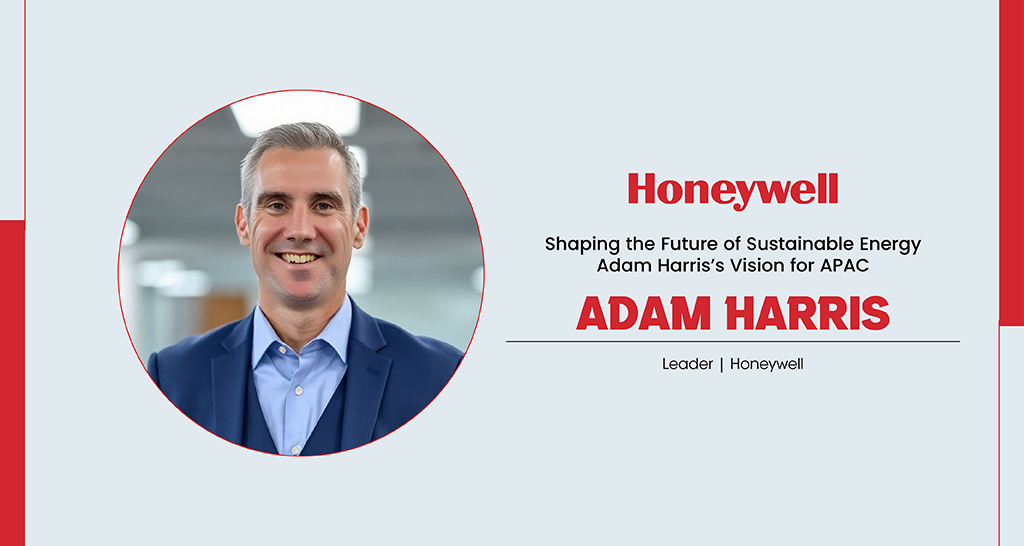

A purpose-driven market leader and seasoned expert, Adam Harris holds over 26 years of extensive expertise in the energy sector. As the APAC Pole Leader for Oil and Gas at Honeywell, Adam is passionate about harnessing the power of digital transformation to shape the future of energy. His leadership philosophy is built on purpose-driven collaboration, empowering teams to challenge assumptions and co-create globally scalable and locally relevant solutions.

Adam’s career in the energy sector has been driven by a strong interest in automation and technology and their influence on operational efficiency and innovation within the industry. Early in his career, he was drawn to the complexity and scale of the industry—how energy company operations intersected with global markets and geopolitical dynamics. But what truly captivated him was the potential for digital transformation. Even in the early 2000s, it was clear that the energy sector would need to evolve to meet growing environmental and societal expectations. That sense of purpose—of being part of a sector that must innovate to remain relevant—continues to fuel his passion today.
As a leader, Adam prioritizes empowerment, agility, and inclusivity, encouraging his teams to challenge assumptions, embrace local customer insights, and co create solutions. He is a strategist and catalyst who transforms complexity into clarity, vision into action, and partnership into performance. He leads with foresight, executes with precision, and empowers teams to shape the future of energy and automation across the Asia Pacific.
Navigating the Complexities of Energy Transition
The oil and gas, refining, and petrochemical sectors are facing unprecedented challenges and opportunities. Three key areas stand out: decarbonization pressure, digital transformation, and talent acquisition and transition. Decarbonization pressure is accelerating due to regulatory frameworks and investor expectations, making low-carbon operations existent. Digital transformation is reshaping operational models through AI, IoT, cloud computing, and advanced software and analytics. Talent acquisition and transition require recruiting and retaining expertise in sustainability and digital technologies. These challenges and opportunities are interrelated rather than occurring in isolation. Effectively addressing them necessitates a comprehensive vision and strategy that integrates innovation, organizational entrepreneurship, and regulatory reform.
Pioneering Sustainability: Honeywell’s Journey
Honeywell has demonstrated leadership in aligning its strategic objectives with global energy and sustainability trends. In the Asia-Pacific region, this commitment is reflected through investments in advanced technologies that support large-scale decarbonization, including carbon capture solutions, hydrogen production, and Power-to-X process technologies. These efforts facilitate the export of renewable energy and enhance the transportation and supply chain capabilities for low-carbon-intensity products. Additionally, Honeywell focuses on energy-efficient process controls and robust emissions prediction, prevention, and monitoring to further advance sustainable operations.
Honeywell has moved beyond product-centric thinking to solution ecosystems that integrate hardware, software, and engineering. Its partnerships with governments, refiners, and industrial players reflect a shared commitment to net zero goals, tailored to the unique energy profiles of each market.
Achieving Balance in Energy: Sustainability, Profitability, and Safety
Established players in the energy sector often face a difficult balance between profitability, safety, and sustainability. However, experience suggests that these critical aspects can and must coexist. The secret to success lies in enhancing the agility and flexibility of energy company operations.
By embracing autonomous operations, leveraging responsible AI adoption, and harnessing IoT data, organizations can strike an optimal balance between competing objectives. This strategic approach enables predictive capabilities and operational support that minimize safety incidents, boost reliability, reduce energy expenses, and lower emissions, while maximizing throughput for higher-margin products.
By integrating sustainability into core key performance indicators (KPIs) and monitoring progress in real time, companies can ensure that sustainability is embedded in their business strategy rather than treated as a standalone initiative. Effective integration of environmental, social, and governance (ESG) metrics with operational objectives effectively integrated with operational objectives makes the transition to sustainable practices a standard business norm instead of a separate function or compliance requirement.
Accelerating the Adoption of Low-Carbon Energy Products
The adoption of green energy products is progressing at a slower pace than expected, mainly due to limited carbon pricing mechanisms and low penalties for emissions. Furthermore, the Levelized Cost Of Hydrogen (LCOH) remains too high, lacking the economies of scale and technological advancements necessary for financial viability and project approval.
Although the pace is gradual, several incentives and market enablers are emerging that will support the adoption of low carbon energy products across Asia-Pacific in the future. These include carbon pricing and trading mechanisms being implemented in various countries to encourage sustainable practices. The expansion of ESG-linked sustainability funds is facilitating capital allocation for decarbonization-linked companies and projects. And the national targets and subsidies for net-zero energy projects are encouraging certain developments and supporting early-stage challenges.
These catalysts are reshaping investment priorities and encouraging cross-sector collaboration. The momentum is only at the beginning of the curve, and it must continue to have catalysts to ignite the growth, like government incentives to help early adopters and policies that reduce uncertainty on long-term investments.
A Balanced Energy Future: The 2030+ Energy Outlook
Looking ahead to 2030 and beyond, Adam envisions a more balanced energy blend in the Asia Pacific region. Conventional energy will remain vital, particularly for industrial and transport sectors, but its carbon footprint will be significantly reduced through efficiency upgrades and carbon abatement technologies. Renewables—especially solar, wind, and green hydrogen—will gain ground, driven by low costs to produce and supported by improved storage solutions and grid modernization. The transition will not be uniform, but the trajectory is clear: a hybrid energy ecosystem that blends reliability with sustainability.
Emerging Technologies in Energy
Several breakthroughs excite Adam about the next phase of the energy transition. These innovations include advanced electrolysis for green hydrogen, AI-driven autonomous operations, carbon capture and utilization (CCU), and facilitating a market for low carbon intensity (CI) products. Advanced electrolysis for green hydrogen lowers the levelized cost of hydrogen and improves scalability, unlocking new applications across the distribution network. AI-driven autonomous operations are enabling real-time companies to move towards safer, more reliable, and, importantly, less carbon-intensive operations.
Carbon capture and utilization is turning CO₂ into valuable products, which could be a game-changer for the energy industry. Facilitating a Market for Low Carbon Intensity (CI) Products involves comprehensive real-time monitoring and reporting of CI, down to a product or shipment level. Lower CI levels can support premium pricing models or lower carbon price import fees. These technologies are being piloted and deployed across APAC.
Shaping a Sustainable Energy Future: Legacy and Leadership
As Adam reflects on his career and looks to the future, he is driven to help shape a more sustainable, inclusive, and resilient energy future. This vision is pursued through mentoring the next generation of leaders, championing diversity in energy innovation, and ensuring that strategies leave a positive imprint on both people and the planet.
In this crucial moment, the energy sector stands at a crossroads. The choices made today will define the world of tomorrow. Adam is proud to be part of this journey and committed to leading with integrity, vision, and impact across Asia-Pacific and beyond.