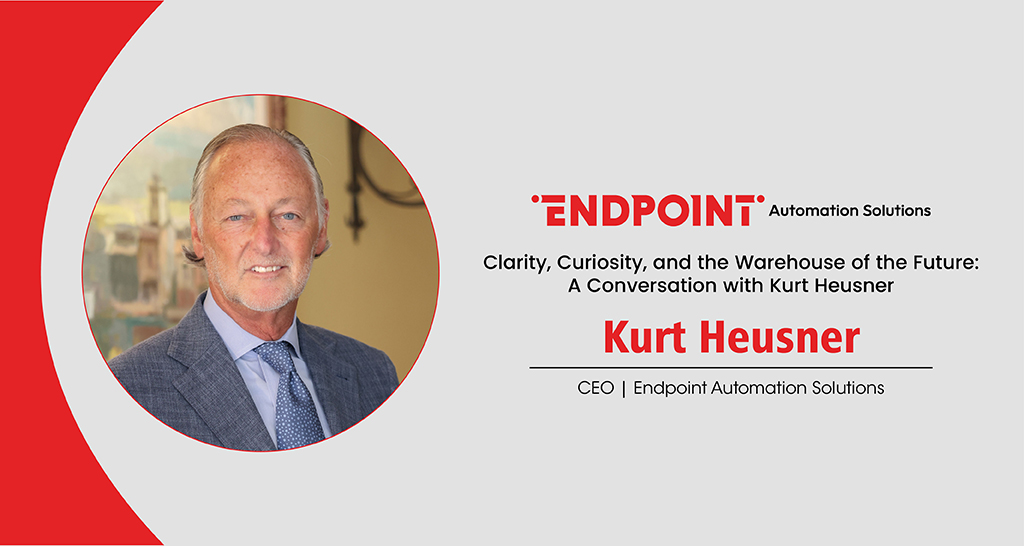

The Endpoint CEO on transformation, culture, and making technology accessible for small and medium-sized businesses

Kurt Heusner has built a career around empowering small and mid-sized businesses to punch above their weight. At Citrix ShareFile, he was instrumental in scaling the modern client experience platform into the hands of tens of thousands of small business owners, culminating in its acquisition by Progress Software earlier this year. Now, as CEO of Endpoint Automation Solutions (formerly Scanco), he’s applying that same customer-centric vision to one of the timeliest challenges facing small and midsize manufacturers: how to bring agility to warehouses, shop floors, and supply chains in an era of unprecedented trade ambiguity, tariffs, and inflation-related pressure.
Endpoint has evolved from its barcode-scanning roots through acquisition into a robust warehouse automation provider. Under Heusner’s leadership, the company is positioning itself not just as a warehouse management system (WMS) vendor, but as a category-shaping platform that helps mid-market firms bridge the gap between ERP systems and real world operations.
We sat down with Heusner to talk about his guiding principles, Endpoint’s transformation, and the future of automation.
Your career spans industry business model changes, transformation, turnaround leadership, and hyper speed innovations—what personal principles have remained constant throughout those shifts?
No matter the context, a few principles have remained constant for me.
First is clarity of purpose. People can deal with a lot of change if the ‘why’ is clear. I focus on anchoring teams around a shared mission, helping everyone see the impact of their work and where we’re headed.
Second is empowerment over control. Real transformation doesn’t happen through top-down mandates—it comes from unlocking the potential of the people closest to the work. My role is to create an environment where people feel trusted, informed, and accountable.And finally, progress over perfection. In times of uncertainty, speed matters. I value bias for action and experimentation over waiting for the ideal conditions.
That focus on empowerment seems connected to how you communicate vision. You’ve emphasized visual thinking and human-centered design—how do those shape your leadership approach?
Visual thinking and human-centered design are both strategic and personal for me. I have a dyslexic form of thinking that processes the world spatially and conceptually. I learned early to see the value in what it brings—a natural ability to simplify the complex and communicate through visuals rather than dense text. It helps me shape strategy, design around real behavior, and make vision feel accessible and actionable.
Human-centered design reinforces this mindset. It demands empathy. It asks you to start with the user, the employee, and the partner, and work outward. That’s influenced how I approach everything from product strategy to team alignment.
Endpoint is going through an evolution at the moment, executing on a new vision grounded in Scanco’s barcode scanning roots. What were the pivotal moments in that transformation?
The transformation from Scanco to Endpoint was much more than a rebrand. It marked a shift in mindset, market, and mission for the team.
One key moment was recognizing that we weren’t just solving barcode and data collection problems. We are sitting at the intersection of complex operational systems that need to work together intelligently and intuitively. That reframed our ambition from building tools to powering entire ecosystems.
Another turning point was our platform overhaul. We moved from point solutions to a composable, cloud native architecture. That meant rethinking talent, CX, and GTM strategy. It also meant grounding that bold change in empathy for customers, partners, and the legacy systems we’d grown up around.Curiosity and trust—core values that will carry us forward from a niche software vendor to a category shaper.
Speaking of shaping categories, Endpoint now serves very different businesses ranging from industrial manufacturers to food and beverage distributors. How do you ensure the platform scales and adapts across them?
We design for flexibility from day one. Our customers range from fast-scaling SMBs to large, complex enterprises. That diversity requires a platform that’s modular, deeply integrative, and adaptable to the tools companies already use. So we continue to build Endpoint to be cloud-native and API-first—you could think of that as simplifying how we connect (and disconnect) from most ERPs or tools. We avoid brittle, hard-coded customization in favor of robust configuration. We want users to be able to tailor the experience, adjust as they grow, and still benefit from our constantly improving platform.
Beyond the product itself, we design scalability into our delivery model. We co-design with customers, listen continuously, and measure success based on operational outcomes, not just usage metrics.
Looking ahead, technology itself is shifting quickly. Which trends are shaping your roadmap?
Several areas seeing enormous advancement are guiding our development priorities:
AI-Driven Predictive Intelligence: We’re embedding machine learning to help teams move from reactive firefighting to proactive, data-informed decision-making. That spans demand forecasting, capacity planning, exception handling, and early risk detection.
Actionable Insights: Analytics only matter if they drive action. We focus on clarity and speed—highlighting the metrics that influence decisions without overwhelming teams with too much data with no intended purpose.
IoT-Enabled Real-Time Visibility: We’re planning to integrate sensors and edge intelligence to improve asset utilization and provide live visibility across warehouses, factories, and distribution networks.
Configurable Automation: Non-technical users will be able to design, update, and deploy their own workflows—flexible tools with guardrails for scale and governance.
Cloud-Native, API-First Infrastructure: We’re re architecting the platform for the cloud, with an API f irst design that makes it easy to plug into ERPs like NetSuite, Microsoft, Acumatica, and Sage—or disconnect just as easily.
Computer Vision & Digital Twins: We’re testing vision-based inspection and task verification to reduce manual friction. Paired with digital twins, this lets teams simulate environments virtually before making real-world changes.
And zooming out—what’s your vision for the role of automation in mid-market and enterprise businesses over the next five years?
Over the next five years, I believe automation will shift from a tool for efficiency to a strategic layer for agility. It’ll no longer be about fixing isolated processes. Instead, automation will become the connective tissue that helps businesses respond in real time to labor challenges, supply chain shifts, and new customer demands. We’ll see more composable automation where users orchestrate workflows without waiting on IT. Platforms will learn, recommend, and sometimes act on their own. But critically, the best systems will still leave room for human judgment.
On a more immediate note, are there upcoming initiatives or partnerships at Endpoint that you’re excited about?
Absolutely. We’re preparing to launch the next generation of our platform that brings automation closer to the end user, makes it easier to configure, and integrates more deeply with ERPs.
We’re also forging partnerships with ERP providers and industrial automation players to offer more seamless end-to end solutions. The goal is to remove friction from implementation all the way through insight. We’re also building AI, predictive analytics, and extensibility into the DNA of our products.