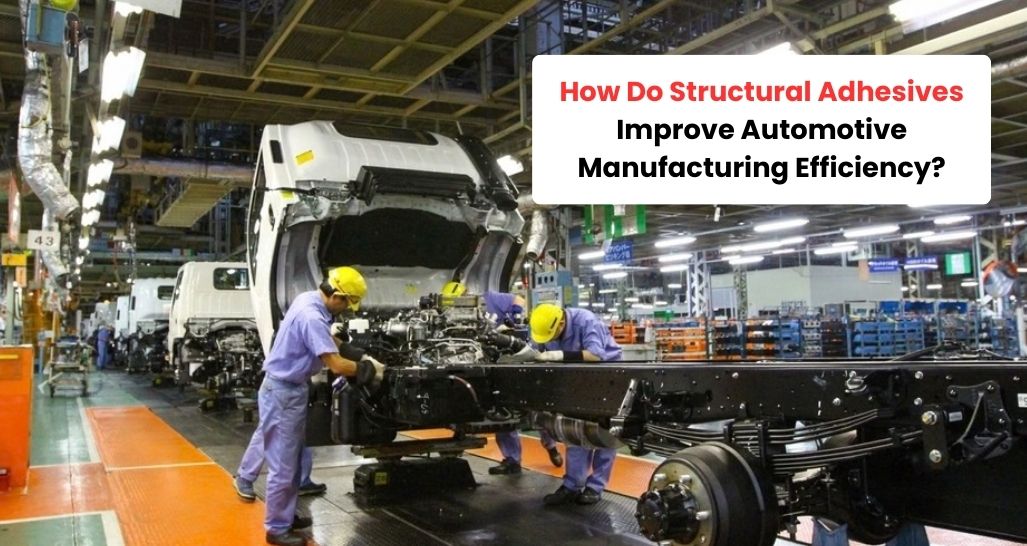

In the competitive landscape of automotive manufacturing, efficiency is more than a priority. In fact, it is a foundational requirement for profitability, quality, and innovation. As vehicles become lighter, more complex, and increasingly electrified, traditional fastening methods such as welding, riveting, and mechanical joining are facing structural and economic limitations. Manufacturers are therefore adopting advanced bonding technologies to improve production speed, structural integrity, and material flexibility.

Among these technologies, structural adhesives have emerged as a critical enabler of modern automotive efficiency. When selected and implemented strategically, they reduce assembly complexity, enhance performance, and support scalable manufacturing systems.
That said, below is a structured analysis of how structural adhesives improve efficiency across automotive production. So, let’s discuss in the article!
1. What Are Structural Adhesives?
Structural adhesives are high-strength bonding materials designed to permanently join components while withstanding mechanical loads, vibration, temperature changes, and environmental exposure. Unlike standard sealants, they contribute directly to the structural integrity of automotive assemblies.
In vehicle manufacturing, they are commonly used for:
- Metal-to-metal bonding.
- Composite-to-metal joints.
- Plastic-to-metal assemblies.
- Structural reinforcements.
However, selecting the right adhesive chemistry is important for both performance and manufacturing efficiency. Engineers typically consider bond strength, durability, curing requirements, and compatibility with different materials before finalizing a solution.
The good news? Some industry leaders, such as Permabond, provide technical resources that help engineers compare adhesive chemistries based on real application needs. For example, their detailed comparison of epoxy vs acrylic adhesives outlines how each chemistry performs under structural demands and manufacturing constraints.
For a fact, epoxy adhesives are often selected for high-load structural applications. This preference is largely due to their superior mechanical strength, excellent resistance to heat and chemicals, and dependable long-term performance under vibration and fatigue. Acrylic adhesives, by contrast, are frequently chosen where faster curing and broader surface tolerance are priorities.
Once the appropriate structural adhesive is selected, the next step is understanding how it directly improves production speed, assembly efficiency, and overall manufacturing performance.
2. Reducing Assembly Complexity and Time
One of the most direct ways structural adhesives improve efficiency is by simplifying assembly processes. Traditional joining methods often require multiple steps, fixtures, specialized tooling, and skilled labor. For example, spot welding requires precise alignment, specific welding equipment, and additional finishing to smooth weld spots. In contrast, adhesives can bond large surface areas uniformly, reducing the number of discrete joints and associated processing steps.
Structural adhesives facilitate:
- Fewer fasteners: Eliminating or minimizing the use of bolts, screws, and rivets streamlines assembly and reduces part counts.
- Simplified tooling: Adhesive bonding often requires less complex fixturing compared to welding or mechanical joining.
- Concurrent operations: With proper curing strategies, adhesive application and curing can occur alongside other production activities, improving line utilization.
By reducing assembly complexity, manufacturers can shorten cycle times, decrease labor costs, and accelerate throughput without compromising joint performance.
3. Enabling Multi-Material Design
Automotive design has evolved toward the use of multi-material architectures that combine high-strength steels, aluminum, composites, and polymers. These materials are selected to improve strength-to-weight ratios, enhance crash performance, and support fuel efficiency or electrification goals. However, joining dissimilar materials poses significant challenges for conventional joining methods due to differences in melting points, galvanic compatibility, and mechanical properties.
Structural adhesives provide an effective solution by creating bonds across dissimilar substrates without introducing stress concentrations or thermal degradation. For instance, bonding aluminum to carbon fiber composites or joining plastics to metals can be achieved with adhesives that are formulated to maintain integrity under varying loads and environmental conditions.
This capability improves manufacturing efficiency in several ways:
- Design flexibility: Engineers can specify materials based on performance needs rather than joining constraints.
- Weight reduction: Efficient multi-material bonding contributes to lighter vehicles, leading to improved fuel economy and reduced emissions.
- Fewer corrective processes: Eliminating differential thermal stresses reduces distortion and part rework.
By facilitating multi-material integration, structural adhesives enable manufacturers to innovate without compromising on production efficiency or structural reliability.
4. Enhancing Structural Performance and Durability
Structural adhesives contribute to improved vehicle performance by distributing loads more evenly than point-to-point mechanical fasteners. In applications such as body-in-white assembly, adhesively bonded joints can increase torsional stiffness and overall rigidity. This enhances ride quality, safety, and crash performance while simultaneously supporting efficient assembly.
Some key performance advantages include:
- Improved fatigue life: Adhesive bonds reduce cyclical stress concentrations, extending the lifespan of components.
- Corrosion resistance: Adhesives act as barriers that protect bonded surfaces from moisture and contaminants, mitigating corrosion-related degradation.
- Vibration damping: The viscoelastic nature of many structural adhesives helps absorb and dampen vibrations, reducing noise, vibration, and harshness (NVH) in the finished vehicle.
These performance benefits translate into long-term efficiency gains by reducing warranty claims, maintenance needs, and structural failures.
Conclusion
Structural adhesives are reshaping automotive manufacturing by enabling more efficient, flexible, and robust production processes. By simplifying assembly, supporting multi-material design, and enhancing structural performance, adhesives help manufacturers meet evolving industry demands.
All in all, with strategic selection and application, structural adhesives unlock measurable efficiencies across design, production, and lifecycle performance. As the automotive industry continues to innovate, structural adhesives will remain a key enabler of efficiency, quality, and competitiveness in manufacturing.