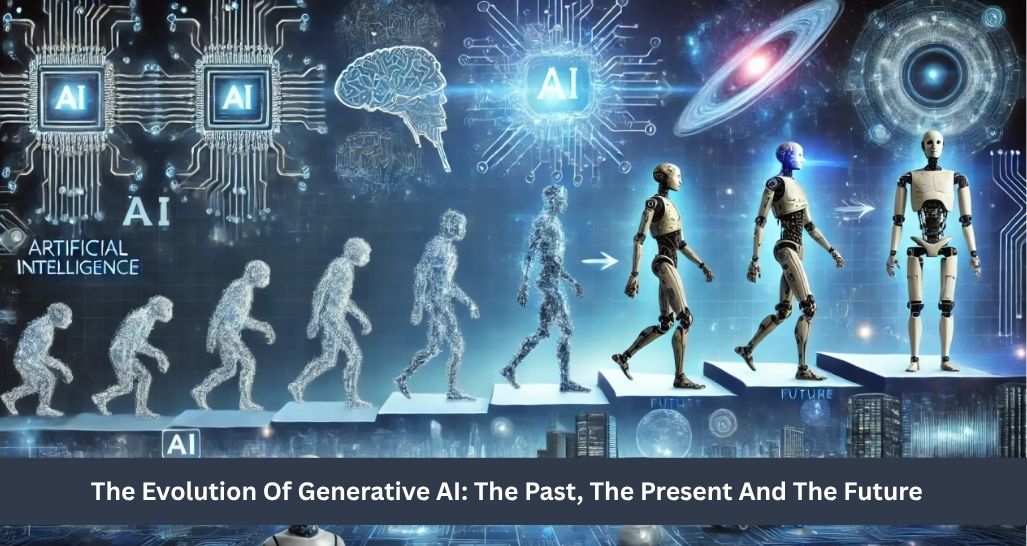

Generative AI has come a long way in a short amount of time. 10 years ago, artificial intelligence still felt like a sci-fi concept. Nowadays, generative AI is everywhere – over 50% of content on the internet is believed to be AI-generated. How did we get here? And what will things look like in the future? Let’s go back to the beginning and get a better understanding of how generative AI has evolved.

The Past
It’s possible to trace generative AI all the way back to the 1960s. The first chatbot, ELIZA, was produced in 1966 – it was designed as a digital psychotherapist and responded to keywords by asking questions. Although it relied on a fairly limited script of responses, it fooled many people at the time into thinking they were talking to a real psychotherapist.
The first AI-generated images would appear a decade later, produced by Harold Cohen’s AARON. This computer program produced original artworks based on rules and parameters set by Cohen. Although very slow and rudimentary at first, Cohen would continue to train it over the decades to produce more detailed drawings at a faster speed – eventually using color.
Generative AI would continue to develop throughout the 2000s, but a major watershed moment was 2018 when OpenAI unveiled GPT-1, the first large language model (LLM). This AI program changed the game by using masses of data to produce much more nuanced text responses than previous models that mostly chose from a selection of scripted answers.
Text-to-image generation would truly take off a few years later. In January 2021, OpenAI introduced Dall-E – although its images look fairly by today’s standards, they were much more high-quality and relevant than the fairly abstract AI-generated images that preceded. Midjourney came out shortly after and pushed the envelope even further with even more realistic image generation – in March 2023, an image of Pope Francis wearing a Balenciaga puffer jacket famously duped much of the internet, proving that AI-generated images were now much harder to distinguish.
AI-generated videos came soon after. Early models produced fairly trippy and bizarre results (a notable example being a viral video of Will Smith eating spaghetti in 2023). These videos would too become higher quality – especially with the arrival of Sora in 2024. A landmark moment is thought to be an AI-generated video of rabbits jumping on a trampoline released in 2025, which most people thought was real.
The Present
In 2026, generative AI is now at a stage where basic text prompts can produce text articles, images and videos that feel organically made. While hallucinations and errors still exist, they are quickly being ironed out.
Image generation models like Google’s Nano Banana are now able to use deep semantic understanding to create much more precise images. The programs also provide much more precise control when editing, so that designers can conjure images exactly as they imagine them.
LLMs like GPT-5 meanwhile provide much contextual understanding, creativity and interactivity for much more detailed and accurate answers and written content. Such models have also gone multimodal and can now interpret images and videos on top of text prompts.
When it comes to generative AI video content, the likes of Sora are now able to produce videos with sound that follow narratives. Such tools have become widely adopted by educators, marketers and creatives – reducing the need to hire videographers, actors and animators for short-form content.
Right now, the power of this technology remains incredibly impressive. But there is a lot of backlash that has been mounting – especially in regards to non-consensual deepfakes, misinformation and the potential devaluation of human art as AI-generated songs climb into the music charts.
The Future
The future of generative AI remains very uncertain – considering just how quickly it has evolved and how unprecedented its meteoric rise has been even by many experts, there’s no telling quite where it will be in 5 or 10 years time.
One interesting development is the EU AI Act, which is expected to come into place later this year. This act will set guidelines regarding privacy, transparency and accountability to help AI-generated content adhere to ethical standards, while also respecting intellectual property rights. Countries around the world are expected to introduce similar laws as time goes on. These laws will likely continue to change as new AI innovations are introduced.
The coding landscape seems to be where generative AI is taking over next. Already, models are helping developers to assist with the writing and debugging of code. However, we could see much greater amounts of code written by AI in the next few years – giving those with no programming experience the ability to produce high-quality websites, apps and video games with a few text prompts.
AI is also likely to cross over into the physical world as robotics advance. We could start to see robotic self-service scanners and autonomous vehicles that have integrated LLMs that allow for conversations, helping to humanize robots in the real world. Robots could also be used to design and build items and potentially even work on buildings and structures. This could help to greatly speed up construction and engineering projects.
The rise of agentic AI – AI systems that can operate autonomously and make decisions – will also lead to transformative changes across numerous sectors. These systems will not just generate outputs based on user inputs, but will also come up with their own strategies based on learned experiences. This evolution will have profound implications for creativity and problem-solving at work.
Conclusion
The AI landscape has shifted dramatically over the years and will likely continue to experience dramatic changes in the future. Society will need to adapt and regulations will need to keep up to make sure that generative AI is a force for good. It is likely that we are still yet to see the true innovative powers of generative AI. How well will this innovation be accepted by the public? Will it lead to a loss of jobs? Or will it create new exciting opportunities?