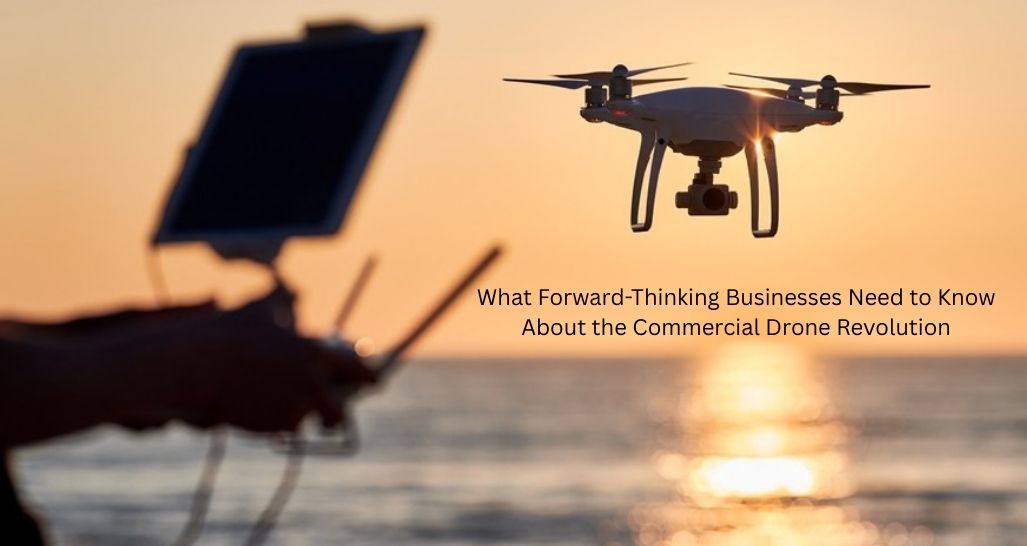

Enterprise unmanned aerial vehicles (UAVs) are not a fad.

They are poised to revolutionize how entire industries work — and the businesses investing in them now are going to leave their competitors in the dust.
Global commercial drone spending crossed $30 billion in 2024 and is on track to reach $54.64 billion by 2030. This is not if. This is happening.
So what should every forward-thinking business know about UAVs?
Here are five things to know to get ahead of the curve.
Here’s What You’ll Learn:
- Why Enterprise UAVs Are Taking Off
- Enterprise UAVs Vs. Consumer Drones
- Commercial Industries Investing in UAVs
- Choosing the Right Enterprise UAV
- Wrapping it all up
Why Enterprise UAVs Are Taking Off
Commercial UAV adoption isn’t coming from hobbyists.
It’s coming from companies large and small that understand how UAVs solve expensive problems quicker and cheaper than traditional methods.
How quickly can an enterprise UAV solve those problems?
Well…
Construction project managers can map an entire job site in less than an hour.
Energy companies can inspect 20 miles of pipelines without risking worker safety.
Farmers can analyze thousands of acres of crops for signs of stress before they’re visible to the naked eye.
All. In. A. Day.
WISPR, an American-made drone company, has built their business exclusively around engineering purpose-built UAVs here in the U.S. versus selling cheaper consumer drones.
Enterprise UAVs are built for a purpose.
The numbers prove it too. Enterprise drone adoption has surged, with 32% of enterprises now deploying UAVs for operational improvements — a figure driven by 41% growth in inspection and monitoring applications alone.
Once businesses see the ROI, they are not going back.
Enterprise UAVs Vs. Consumer Drones
Let’s make one thing clear…
There is a world of difference between a $300 hobby drone and an enterprise UAV.
Enterprise UAVs have superior hardware. They have more advanced sensors. Enterprise UAVs have robust software platforms. And they also have support teams that specialise in ensuring the UAV works when it’s needed… day in and day out.
Consumer drones are built to be affordable and easy to use. That is their purpose. But just because consumer drones are lightweight doesn’t mean they should be used for enterprise-level problems.
Here’s what enterprise UAVs are built for:
- Longevity — While consumer drones fall apart after a few flights, enterprise UAVs are built to withstand hundreds of hours of heavy use.
- Heavy Lifting — Switching out sensor payloads — whether it’s thermal, RGB, LiDAR, or something else — enterprise UAVs can handle it. Consumer drones cannot.
- Flight Times — What good is a drone that can’t stay in the air long enough to do its job? Enterprise UAVs fly longer than most consumer models.
- Easy Integration — A UAV should fit into an existing workflow, not the other way around. Enterprise UAV manufacturers understand this. Consumer drones do not.
- Security — UAVs used for government contracts or critical infrastructure need to be American-made. There is no shortcut here.
Understanding the difference between an enterprise UAV and a consumer drone will save a significant number of headaches down the road.
Commercial Industries Investing in UAVs
Commercial UAVs are taking off in just about every industry.
Here are just a few that are changing the game.
Construction and Infrastructure
Enterprise UAVs are a growing tool for construction companies looking to survey job sites and capture progress from the air. Companies that used to hire surveying crews are finding they can reduce costs by up to 40% by using drones. For a large-scale commercial job, that can pay for an entire UAV program tenfold.
Energy and Utilities
Want to inspect power lines? Check. Wind turbines? Done. Solar panels? No problem.
That’s just a small sample of what enterprise UAVs are doing for energy and utilities companies looking to replace expensive helicopter contracts. Enterprises that have made the switch are seeing a 40% reduction in transmission-line inspection costs.
Agriculture
Farming is another industry that drones are changing from the ground up. Drone-aided farming increased by 35% throughout the United States in 2024 alone. Commercial UAVs covered an estimated 12 million acres of U.S. farms by allowing operators to better manage their operations and react quickly to any signs of crop stress.
Logistics and Delivery
Need a breakthrough in a logistics and delivery strategy? Enterprise UAVs just might be the answer.
Already one of the fastest-growing segments of the entire commercial drone market, enterprises across the country are testing UAVs for delivery.
The reason? Everyone wants to figure out how to tackle the last-mile problem.
Choosing the Right Enterprise UAV
Here are a few things worth evaluating before talking to any commercial UAV provider.
Know your regulations — Commercial UAV operations need to be Part 107 compliant. That’s just table stakes. If the UAV operation is likely to grow beyond line-of-sight flights, look for providers that have proven experience with BVLOS waivers.
Consider security and supply chain — Where are the UAVs made? Where does data go when it’s uploaded? If the business deals with government work or critical infrastructure, this will be incredibly important. American-made UAVs with a domestic supply chain provide that extra level of confidence and security.
Flexibility of payload — Sensor payloads aren’t one-size-fits-all. The best enterprise UAV providers allow operators to swap payload sensors to meet the needs of any given operation. Need thermal imaging? Switch out the multispectral sensor. Need RGB? Done. Top operators have multiple sensors and use each one when needed.
Software is king — Does the UAV provider’s software integrate with existing analytics tools? If not, it’s just a flying camera. Robust API access and easy-to-use data pipelines are non-negotiable.
Factor in total cost of ownership — Operating UAVs involves more than buying hardware. Team training, maintenance, software costs, and ongoing operations should all be factored in before making a final decision. The cheapest upfront option is rarely the most cost-effective over time.
Wrapping It All Up
To put a bow on this:
Enterprise UAVs are here.
Commercial UAV technology is here.
And businesses everywhere are starting to realise just how much money can be saved by incorporating drones into their operations.
That’s why…
- Enterprise UAVs are quickly becoming a must-have for forward-thinking businesses.
- Commercial industries from construction to agriculture are realising ROI.
- Proper due diligence is required when selecting an enterprise UAV provider.
If a business hasn’t yet considered UAV technology, it’s worth asking how long it can afford to wait.