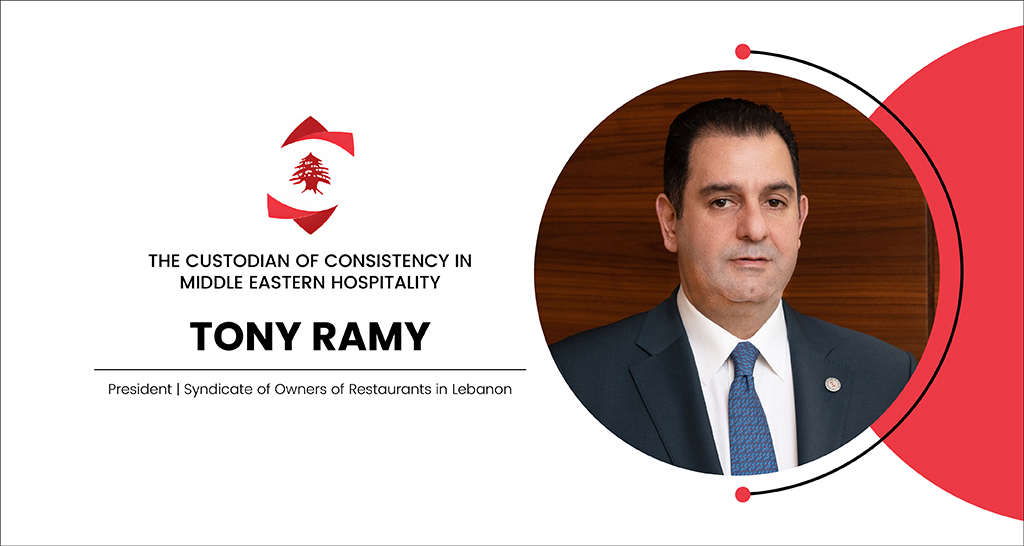

For Tony Ramy, Syndicate of Owners of Restaurants, Cafés, Night Clubs and Pastries in Lebanon. hospitality was never a career chosen from a list; instead, it was a life inherited, learned, and lived. As President of the Syndicate of Owners of Restaurants in Lebanon and a lifelong restaurateur, Ramy embodies a rare depth of experience shaped by decades on the front lines of the industry. His story began long before titles or leadership roles, rooted in a family business founded in 1961.

Trained by his father from the ground up, starting, quite literally, by washing dishes, Ramy learned hospitality not as a theory, but as a craft. Those early years instilled a philosophy that continues to define his leadership today: hospitality is, at its core, a collective effort. Working side by side with his father under the guiding principle “one for all, all for one,” he absorbed the values of teamwork, accountability, and mutual respect.
Early Lessons That Built a Leader
Growing up in a family-run hospitality business shaped Ramy’s understanding of what truly drives success. He learned early that customers do not fall in love with novelty alone; they return for consistency, familiarity, and trust. Discipline, structure, and repetition were daily lessons that taught him that loyalty is built over time through reliability. These formative experiences ultimately shaped his leadership style as he transitioned from restaurateur to entrepreneur. Ramy leads by example, remains deeply hands-on, and prioritizes systems that allow teams to perform at their best. Above all, he refuses to compromise on quality, believing that consistency is the foundation of any enduring hospitality brand.
Values Forged Through Crisis and Continuity
Over the decades, Ramy has navigated both periods of prosperity and moments of severe crisis. His guiding belief is simple yet unwavering: there is no success without obstacles. The hospitality business, like life itself, moves through cycles, and resilience determines longevity.
Lebanon’s recurring political, economic, and managerial crises tested every aspect of the sector. Currency collapse, instability, and global disruptions demanded adaptability and mental endurance. Throughout these challenges, Ramy remained focused on reputation and long-term commitment, especially toward loyal customers who stood by the business through difficult times. For him, success is not defined by short-term growth, but by trust earned and preserved over generations.
Protecting Brand DNA Across Markets
Managing multiple restaurant concepts across different markets requires a careful balance between creativity and control. Ramy maintains clarity by staying loyal to the core identity of each brand. Rather than changing concepts to suit trends, he believes in refinement.
Each brand under his leadership has a clear DNA visible in its branding, atmosphere, and tasting identity. While minimal adaptation may be necessary in new markets, the essence of the concept remains untouched. This disciplined approach has allowed his brands to retain authenticity while achieving regional scalability.
Leading an Industry Through Unprecedented Times
As President of the Syndicate of Owners of Restaurants, Cafes, Night-Clubs & Pastries in Lebanon, Ramy has shouldered responsibilities far beyond individual business interests. His role has been to carry the collective voice of the hospitality sector to decision-makers and officials.
During Lebanon’s economic collapse and the COVID-19 pandemic, the Syndicate stood firmly by its members, advocating for relief, addressing regulatory bottlenecks, and offering guidance during uncertainty. Under Ramy’s leadership, the Syndicate also launched initiatives to support young professionals and reinforce Lebanon’s image as a top-tier tourism destination. As an advisory body rather than an executive authority, its influence lies in dialogue, representation, and strategic lobbying.
Unity Over Individual Agendas
Balancing advocacy with neutrality is one of the most complex aspects of Ramy’s leadership. Lebanon’s hospitality sector is diverse, encompassing operators of varying sizes, concepts, and priorities. Ramy’s approach has been to create common ground, ensuring that all voices feel represented.
Transparency and fairness guide his decisions. Rather than favoring any single group, he focuses on protecting the stability, reputation, and sustainability of the sector. For Ramy, unity is not about uniformity, but about shared responsibility and collective progress.
The Syndicate’s Role in a Changing Industry
Today, the Syndicate functions as a protective and strategic pillar for Lebanon’s hospitality sector. Acting as a lobbying bridge between F&B investors and key ministries, including Tourism, Labor, Economy, and Trade, it works to defend owners’ interests while reinforcing standards and regulations.
Beyond advocacy, the Syndicate aims to become a trusted database and reference point for the industry. Its broader vision is to help shift Lebanon’s tourism model from a seasonal economy to a sustainable one capable of withstanding shocks and supporting long-term growth.
Resilience, Creativity, and the Lebanese Advantage
Despite immense challenges, Ramy remains confident in Lebanon’s core strengths. The country’s greatest asset, he believes, is its people. Lebanese hospitality professionals are defined by resilience, creativity, and entrepreneurial instinct. Rather than following global trends, they often create them.
From cuisine to nightlife, Lebanon has long functioned as a concept generator for the region. This positions the country as an exporter of ideas and talent more as a franchisor than a franchisee. A rich culinary heritage, vibrant nightlife culture, and deep appreciation for social connection continue to differentiate Lebanon on the regional stage.
What Must Change for Real Recovery
While talent and creativity remain strong, Ramy is clear about what the industry urgently needs. Political and security stability is the first and most critical requirement. Stability creates confidence, while updated and transparent regulations allow the sector to move beyond crisis management.
Many restaurant laws still date back to the 1960s and no longer reflect modern operational realities. Modernizing these regulations would professionalize the sector, discourage speculative operators seeking quick profits, and reduce costly failures caused by poor planning and lack of market research.
Regional Trends Redefining Dining and Leisure
Ramy’s regional experience offers a panoramic view of the Middle East’s hospitality future. Three forces are shaping the next phase of growth. The first is the enduring influence of authentic Lebanese hospitality as a cultural and culinary foundation.
The second is the hyper-competitive evolution of markets like Dubai, Saudi Arabia, and Qatar, where dining is benchmarked against global capitals and driven by immersive, experience-led concepts. The third is the emerging opportunity in markets such as Iraq, where large scale developments signal strong consumer appetite and untapped potential.
A Vision for 2030: From Local Market to Global Exporter
Looking ahead, Ramy envisions Lebanon transforming into the Middle East’s leading incubator and exporter of hospitality concepts by 2030. Lebanese talent already dominates leadership roles across regional markets, serving as CEOs and concept creators.
By harnessing this expertise, Ramy believes Lebanon can export 200 globally competitive F&B franchises by the end of the decade. This ambition, however, rests on one non negotiable condition: political and security stability. With it, Lebanon will not merely recover, it will lead.
Legacy Built on Trust, Not Just Titles
For Tony Ramy, legacy is not measured solely in brands, positions, or expansion. It is defined by trust, ethics, and enduring relationships. His goal has always been to strengthen the businesses he has built while upholding the highest standards of quality, value, and integrity.
Legacy, in his view, is a two-way street earned through respect from colleagues, loyalty from clients, and positive impact on the wider community. In an industry rooted in human connection, that legacy may be his most lasting contribution.