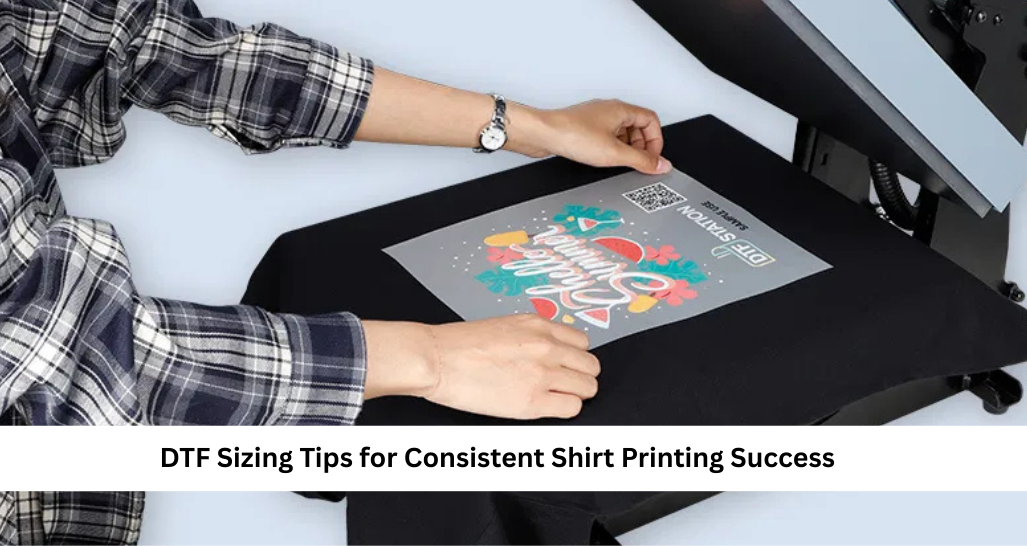

Ever wanted to know the secret to DTF printing perfectly sized and placed shirts every single time?

Get ready because we are about to share exactly that.
Believe it or not, your sizing is one of the most important aspects of DTF printing. In fact, poor sizing is the single biggest reason why DTF transfers fail.
Look at that one design you have. Looks great on a large adult shirt. But try it on a medium youth shirt. Total disaster. Your placement is off by an inch. Suddenly your once professional DTF print looks like an amateur job.
And worse than that, you might not even notice it until the shirt is already printed and ready for shipping.
Okay, time for the good news…
There is a simple method to get your DTF sizing right 100% of the time.
What you will learn:
- The DTF Sizing Basics
- The Sizing Mistakes that Kill DTF Prints
- Design Placement Rules that Work
- Tools & Resources For Perfect DTF Prints Every Time
Why DTF Sizing Is Important
DTF printing is blowing up right now. The global market hit $2.72 billion in 2024 and is expected to reach $3.92 billion by 2030.
Why? Because it works.
DTF delivers quality, vibrant prints on any type of fabric at a fraction of the cost of traditional transfer printing.
The problem is, with more and more people getting into DTF printing the competition is increasing. You can no longer afford to slack on quality.
Customers expect consistent, professional results and the only way to deliver is by nailing the details. And getting consistent results starts with proper sizing.
The best design in the world looks terrible if it’s too big, too small or placed in the wrong spot on the shirt. All your customer is going to see is a poorly made shirt.
The good news is when it comes to dtf sizing for shirts there are tools that allow you to have pre-sized transfers to eliminate the guess work. But whether you are printing your own DTF transfers or buying them pre-made, it is important to know the rules for sizing properly to get professional looking shirts every time.
The Golden Rules of DTF Sizing
Let’s get to the good part…
It’s not about how big or small your design is in theory. It’s about how it looks in real life.
Does it look proportional on different shirt sizes? Is it going to be comfortable to wear? Will it have a professional finish?
If you get any of those things wrong you’re going to get returns, complaints and wasted shirts.
Standard Size Guidelines
Most DTF shirts are going to follow these sizing rules:
Adult Shirts:
- Full front chest prints – 11-14 inches wide
- Left chest logos – 3-4 inches wide
- Full back prints – 12-14 inches wide
Youth Shirts:
- Full front chest prints – 8-10 inches wide
- Left chest logos – 2.5-3 inches wide
- Full back prints – 9-11 inches wide
Again, these are not made up numbers. They’re based on what works in terms of proportion and professional appearance across different body sizes.
The reason I call them a “starting point” is because they are the most common sizes used.
But there are actually more variables in play when it comes to determining the perfect design size for your DTF shirt:
Your Design Type
Is it text? Image? Very detailed? Very simple?
The type of design you’re working with will have a big impact on your size choice.
Style of Shirt
Slim fit? Regular? Loose? Straight cut? Boyfriend style?
Certain styles of shirts require different design sizes than others to look proportionate.
Finished Look
Want to achieve a bold, graphic look? Or a more balanced look?
This is where your personal design style comes into play. You might go bigger or smaller depending on the aesthetic you want to go for.
DTF Sizing Mistakes (And How To Avoid Them)
Okay. Let’s talk about mistakes.
Over the years, I have seen people make the same mistakes over and over again. Let’s go through them so that you can avoid making the same errors.
Mistake #1: One Size Fits All Approach
Your shirt design looks great on a large. So you think all you have to do is print it for the rest of the sizes, right?
WRONG.
Your 12-inch design that looks perfect on an XL will absolutely dominate and overwhelm the rest of a small shirt.
The solution? Scale your designs proportionally. This means you will need to resize your width by about 1 inch for every size down.
Mistake #2: Ignoring Design Complexity
Don’t make the mistake of using the same design size for both very detailed logos and very simple graphics.
A design with small text, fine details, or a lot of small elements needs to be larger to ensure readability.
A very simple, bold graphic can go smaller.
Design complexity is a key sizing consideration.
Mistake #3: Incorrect Placement Measurements
Full front placement is NOT the same as halfway down the shirt.
Standard full front chest placement is 3-4 inches down from the collar seam.
Place your design lower and you risk getting a “belly print”.
Place it too high and it will look cramped up by the neckline.
The rule is this: Measure from the top of the shoulder (at the collar seam) down to the top of where you want your design.
For adult shirts, this will typically be between 3-4 inches. For youth shirts it will be 2-3 inches.
Testing Your Shirt Designs
Here’s how the pros avoid sizing errors. They test.
Print out your design on paper at actual size. Cut it out. Hold it up to different shirt sizes. Look at it.
Does it look balanced? Does it look proportional? Do you want to wear it?
A 5-minute test like this before any production run saves hours of frustration and wasted materials.
DTF Sizing Tools & Resources
One of the best ways to master DTF sizing is to use some physical tools and resources.
Templates (physical and digital)
Create cardboard templates for your most common print sizes.
Measure and cut them out and mark them clearly (Adult Full Front, Youth Left Chest, etc. ).
When you need to check a shirt size for a design, just grab your template and match up the dimensions.
Mockup Software
Mockup software allows you to digitally visualize your design on various shirt colors and sizes before actually printing them.
Size Charts & Calculators
Keep printed size charts handy for all of the different shirt brands you work with.
Brands size their shirts differently. A medium from one supplier might be the same size as a large from another.
Create a simple spreadsheet with your most-used shirt brands and their measurements.
Pro Tips For Consistent DTF Sizing
- Document, document, document. Every time you print a shirt size that works, write it down. Record the shirt brand, size, design dimensions and placement measurements. Build your own shirt sizing library over time.
- Batch similar sizes. When printing multiple shirt sizes with the same design, print all the larges, then all the mediums, then all the smalls. This reduces setup time and also makes it easier to be consistent within size groupings.
- Quality control checks. Before you start a full production run, print a single shirt in each size. Check them. Make sure they all look proportional and professional. It’s a great way to catch errors before they become costly mistakes.
Wrapping It Up
DTF shirt sizing isn’t rocket science. But it is a detail that requires care and a little systemization.
The key takeaways are:
- DTF shirt designs should be scaled proportionally across different sizes
- Placement rules should be followed but adjusted for specific shirt styles
- Testing should be done before every production run
- Size references should be kept for consistency
- Quality control checks should be implemented before going to full production
The demand for custom apparel continues to explode, with e-commerce sales hitting $1.19 trillion in 2024. Your customers are looking for professional results. Give them consistently perfect prints and you will separate yourself from the crowd.
Apply the sizing tips shared here today and get started on improving the quality of your DTF printed shirts. Your prints, and your customers, will thank you.